
Accommodation Trap Webinar
Looks like you missed it! Join the newsletter so you are notified of the next webinar in June.
Dr. Kristi Clarke, Psy.D., BCBA-D, Mom to an Extraordinary Kid

Accommodation Trap Webinar
A free live training for parents who are living inside the weight of one question:
Am I doing too much, not enough — and is it already too late to know?
Thursday, May 7th · 8:00 PM ET / 5:00 PM PT
Free. No replay.
Live Q&A to follow — bring your real questions.
There's a question a lot of parents carry for years before they can name it.
It shows up in the school pickup line. After bedtime, when the house finally goes quiet. Somewhere in the car on the way home from a morning that went sideways again.
Did I just help? Or did I just make it easier to avoid the thing that was hard?
And here's the thing — the support you've been giving wasn't optional. Your child couldn't move forward without it. The accommodations were necessary. They were right. Without them, the mornings wouldn't have happened, the homework wouldn't have gotten done, the meltdowns would have been worse and more frequent and harder to come back from.
But now you're standing at a different question. Not whether you did the right thing — you did. But whether what was necessary then is still what's needed now. Whether the support you're providing is blocking your view of what you're trying to build. Whether you spent years pushing hard because everyone said to — and now that you're finally stepping in, you don't know if that's right either. Whether what works beautifully at home is preparing your child for a world that won't make the same allowances.
It's like the training wheels problem. Take them off too soon and they crash. Leave them on too long and they never learn to balance. And you can't always tell which situation you're in — because the wheels are still there.
That question — the fear of letting go and the fear of holding on, at exactly the same time — is what this training is for.
What this training is: A free, one-hour live session where I walk you through how to recognize when support that was necessary has shifted — or needs to — and what it actually looks like to start adjusting it. Not removing it. Adjusting it. That distinction is the whole conversation.
There won't be a replay — I want to be in the room with you live so I can answer your specific questions in real time.
Grab your spot and we'll figure out the rest together.
Here's just some of what we'll cover
Why this question is so hard to answer — and why that's not because you're missing something obvious. For kids who are wired differently, the line between support that's still building something and support that's now substituting for something is genuinely difficult to see from inside it. I'm going to show you how to read it.
The scaffolding paradox — why the exact support that was necessary at one stage of your child's development can quietly become a different kind of problem at the next stage. Not because you did it wrong. Because scaffolding is supposed to move. And nobody told you when — or how.
What happens when support stays past the stage it was built for — three specific things that develop quietly over time when loving, necessary accommodation doesn't get a chance to shift. Not as a judgment. As a pattern. Once you can see it, you can actually do something about it.
Four kids, four very different patterns — Emma, Marcus, Lily, and Tyler each look completely different on the surface. But the parents in every one of those stories are carrying the same thing you are. The fear of too much. The fear of too little. And not being able to tell which one you're actually looking at.
What adjusting the support actually looks like — not in theory, but in a real story from my own life with my own teenager. This is the part I think will change how you picture what "next" could look like for your family.
One accommodation to look at this week — just one. Not to change it. To examine it. To ask two specific questions that will tell you more about where you actually are than any strategy ever could. This is where the real work starts — and it doesn't require anything except a willingness to look.
Free. Thursday, May 7th · 8:00 PM ET / 5:00 PM PT.
Live Q&A after. No replay — come live.
Who This Webinar Is For:
The parent who can't find the line
"I know too much support is a problem. I know too little is a problem. I genuinely don't know where I am."
That's not a you problem. For kids who are wired differently, that line is legitimately hard to read — and almost no one tells you how. That's exactly what this webinar is for.
The parent who tried pulling back and watched things get harder
"Every time I try to step back, she falls apart worse than before. So I step back in."
That's not failure. That's information. And it points to something specific — something with a way through it that isn't just "try harder to let go."
The parent watching their child thrive at home — and nowhere else
"What we've built works. But I lie awake wondering if I've built something she can only live in here."
That question isn't paranoia. It's one of the most important questions you can ask — and the answer isn't to dismantle what's working. It's to understand what it's actually building. And whether it needs to start traveling with her.
The parent who was told to push harder — for years
"Everyone said more pressure, more consequences, more consistency. I did all of it. And now I'm sitting here wondering what that cost him."
The strategies you were handed weren't built for your child's brain. You weren't doing it wrong. But if you're carrying the weight of what those years felt like — for him, and for you — that weight belongs in this conversation too.
The parent who is exhausted from not knowing
"I second-guess every decision. I just want to feel like I'm on solid ground."
I'm not going to promise you certainty — this work doesn't come with that, and anyone who tells you otherwise is leaving something out. But a clearer question is solid ground. And that's what you'll leave with.
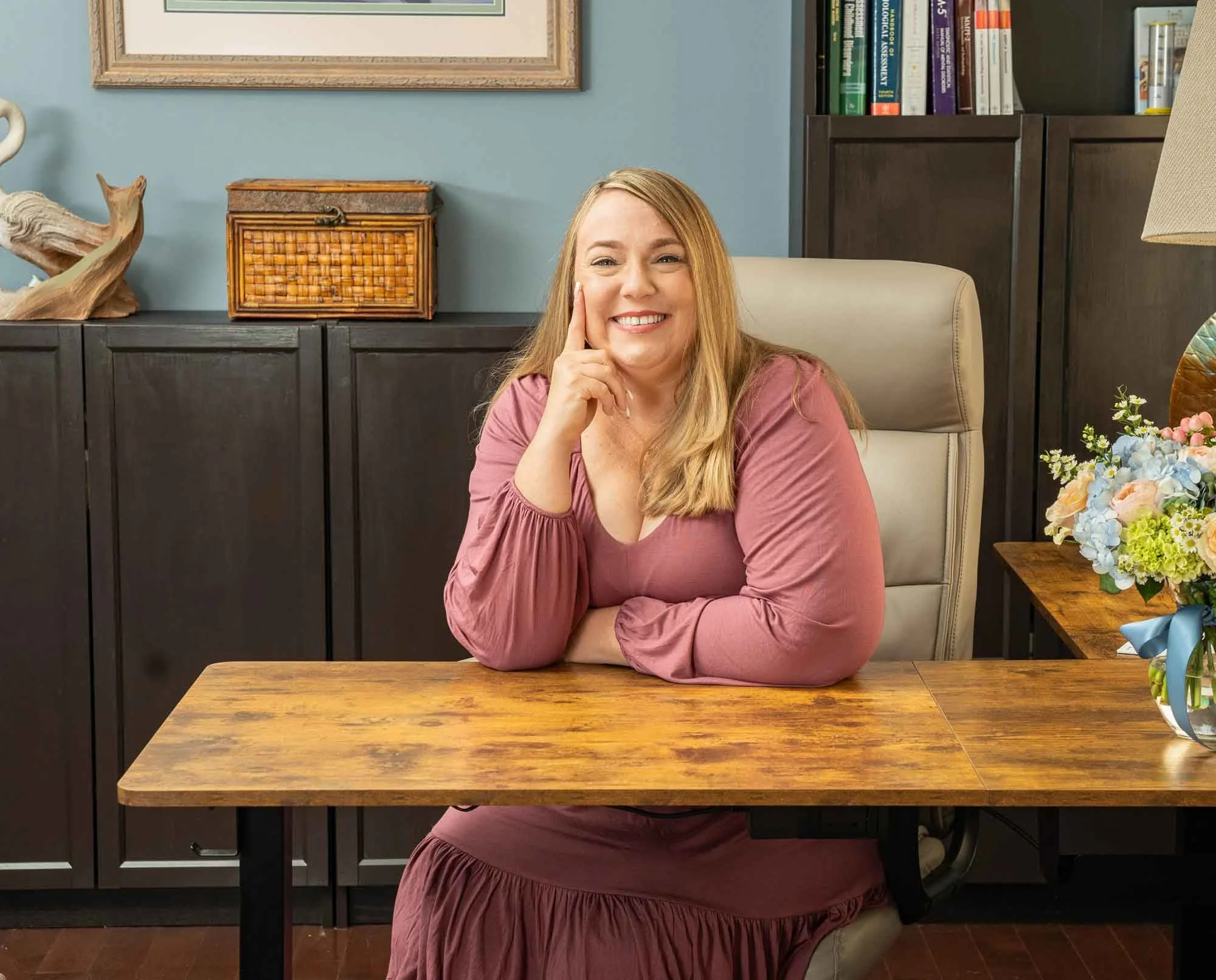
Why Trust Me on This?
I'm a Licensed Psychologist, Board Certified Behavior Analyst, and mom to a teenager who is wired differently. I've spent my career doing both — the assessment work that tells you what's actually happening inside your child's brain, and the coaching and consultation work that helps you figure out what to do with it. For years I also worked directly with kids and families in ongoing therapy, and that work lives underneath everything I teach. And as a mom, I know this question from the inside.
How much is right? When does it need to change? Am I helping, or am I quietly making this harder? I've asked all of it. I still do. I built this training because I spent too long asking those questions completely alone — and I don't want that for you.
Free. Thursday, May 7th · 8:00 PM ET / 5:00 PM PT.
Live Q&A after. No replay — come live.
Still on the fence? Let me answer that.
Is this actually free? Yes. Completely — no cost, no catch. Just show up, bring your questions, and leave with a clearer picture of something you've probably been sitting with for a long time.
Do I need to have been at the first training? No — this one stands completely on its own. If you were there last month, you'll recognize the foundation we're building on. If this is your first time, you'll have everything you need.
My child doesn't have a diagnosis. Does this still apply? Yes. Everything we're covering applies to any child whose brain works differently — whether there's a diagnosis attached or not. If the question feels familiar, this is for your family.
Will there be a replay? There won't be a replay for this one. The live Q&A is where a lot of the real value happens — and that can't be replicated in a recording. If this feels important to you, protect the time and come live. You won't regret it.
How long is it? About 60 minutes of training, followed by live Q&A. No filler. Just the clearest version I can give you of something most parents are carrying completely alone.
The support you gave was necessary. That's not in question. What's in question is what comes next — and whether you have to figure that out alone.
You don't.
Come let me help you answer it.
Free. Thursday, May 7th · 8:00 PM ET / 5:00 PM PT.
Live Q&A after. No replay — come live.